
Why I Grow and Dry Flowers for Winter Rather Than Buying Imported Materials
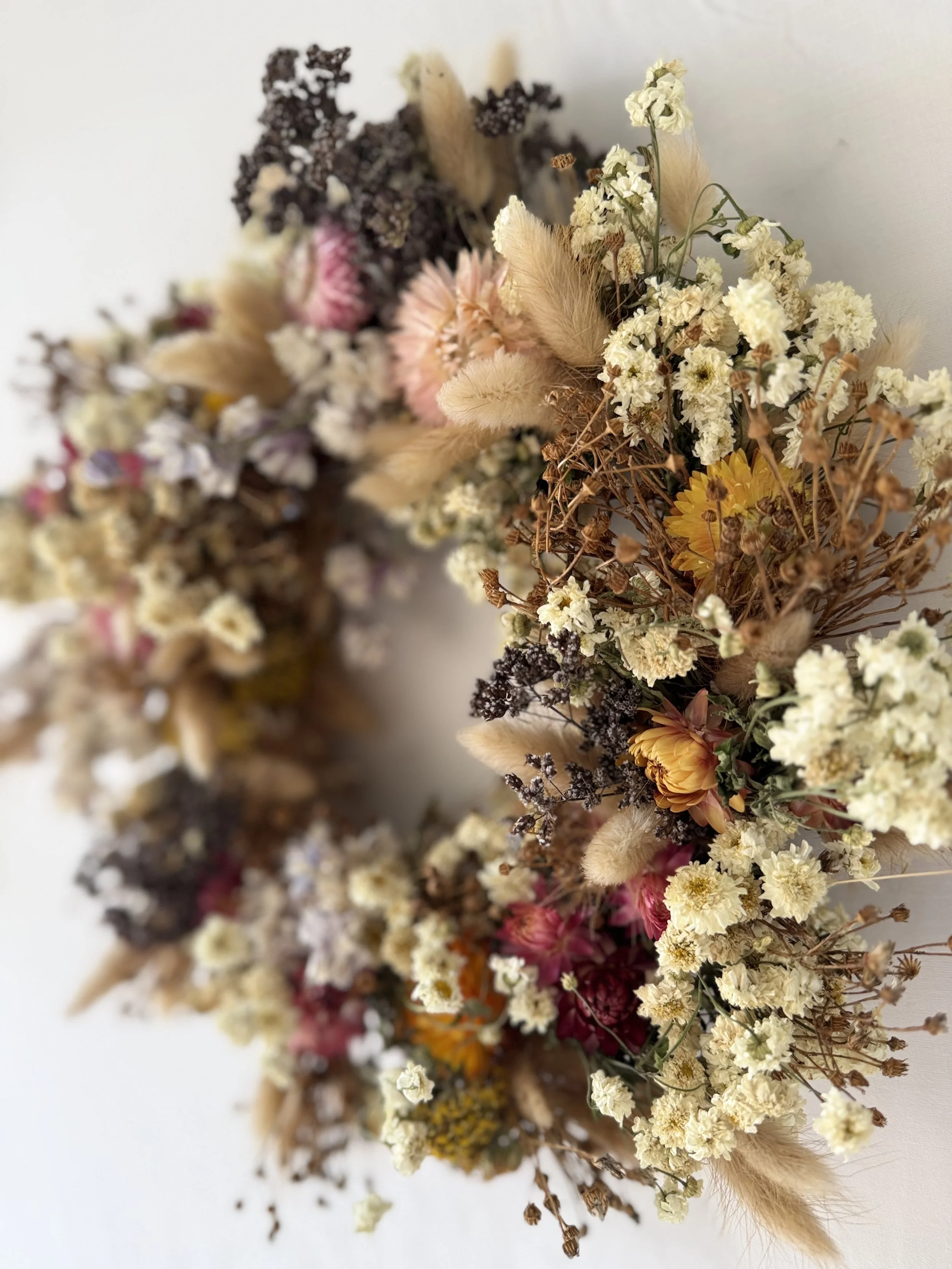
I started growing flowers for the simplest possible reason: I love flowers.
But the more I grew, the more I started thinking about where the flowers we buy actually come from.
Most of us are now familiar with the idea of eating seasonally. We understand why a strawberry grown locally in summer makes more sense than one that's travelled thousands of miles to reach us in the middle of winter.
We talk about food miles. We look for British-grown produce. We think about what's in season and how our food has been grown.
But what about flowers?
We bring them into our homes. We touch them with our hands. We bury our noses in them to smell them. And yet I don't think we always give quite as much thought to where they've come from or how they've been grown.
That's one of the reasons local, seasonal flowers have been fundamental to Cicely Flowers from the beginning.
I'm a grower first and a florist second
I think this is probably the simplest way to explain my approach to flowers: I'm a grower first and a florist second.
I don't start with a picture of the exact bouquet or wreath I want to make and then source whatever flowers I need to recreate it.
I start with what's growing on my flower plot.
What's flowering beautifully? What's abundant? What's gone to seed and suddenly become even more interesting? What's done something completely unexpected?
And then I work from there.
That philosophy doesn't suddenly stop when the fresh flower season ends.
Instead, throughout summer and autumn I'm drying and saving some of what the plot produces, ready to work with during the quieter winter months.
My winter wreaths are still dictated by the growing season. I'm simply using flowers I've preserved rather than flowers I've freshly cut.
What happens to seasonal flowers in winter?
I'm a flower grower in Bradford on Avon, Wiltshire, and I grow outside with the seasons.
That means there comes a point when the abundance stops.
There aren't armfuls of dahlias in December. There aren't buckets of cosmos waiting to be cut in January.
And that's OK.
Rather than trying to pretend it's summer all year round, I like finding ways to work with the season I'm actually in.
For me, drying flowers is one way of doing exactly that.
Throughout summer and early autumn, I'm not only cutting fresh flowers for bouquets. I'm also looking ahead.
I'm cutting and hanging flowers to dry. I'm leaving some plants long enough to develop beautiful seedheads. I'm growing extra grasses and wild carrot specifically because I know I want to use them later.
By the time winter arrives, the fresh flowers may have finished, but I've got boxes filled with pieces of the growing season waiting for me in the garage.
Why not just buy imported flowers?
Of course, I could.
I could decide exactly what I wanted my winter wreaths to look like, find the materials online and order what I needed.
But after spending an entire growing season sowing, planting, tending and cutting my own flowers, there's something that feels slightly ridiculous to me about reaching winter and immediately ordering boxes of flowers that have travelled huge distances to get here.
Imported cut flowers can have a significant environmental footprint through their production, refrigeration and transport. Flowers grown for long international supply chains may also be bred and treated primarily for durability — because they need to survive harvesting, packing, transport and storage before they eventually reach the person buying them.
That isn't what drew me to flowers in the first place.
I love the things that don't travel particularly well.
The scent. The delicate stems. The enormous blowsy blooms. The slightly wonky bits. The varieties chosen because they're beautiful rather than because they'll survive a long journey in a box.
So I don't use imported flowers as part of my normal work at Cicely Flowers.
There have been very occasional exceptions for weddings, when a bride has desperately wanted a particular flower that I couldn't provide. In those cases I've sourced it through another local florist.
But my starting point is always the same:
What is growing here, now?
And in winter, that becomes:
What did I grow and save while it was in season?
Drying flowers has changed the way I look at my flower plot
One unexpected thing about making dried flower wreaths is that it's made me notice plants differently.
A flower isn't necessarily finished once its petals have fallen.
Sometimes that's when it gets really interesting.
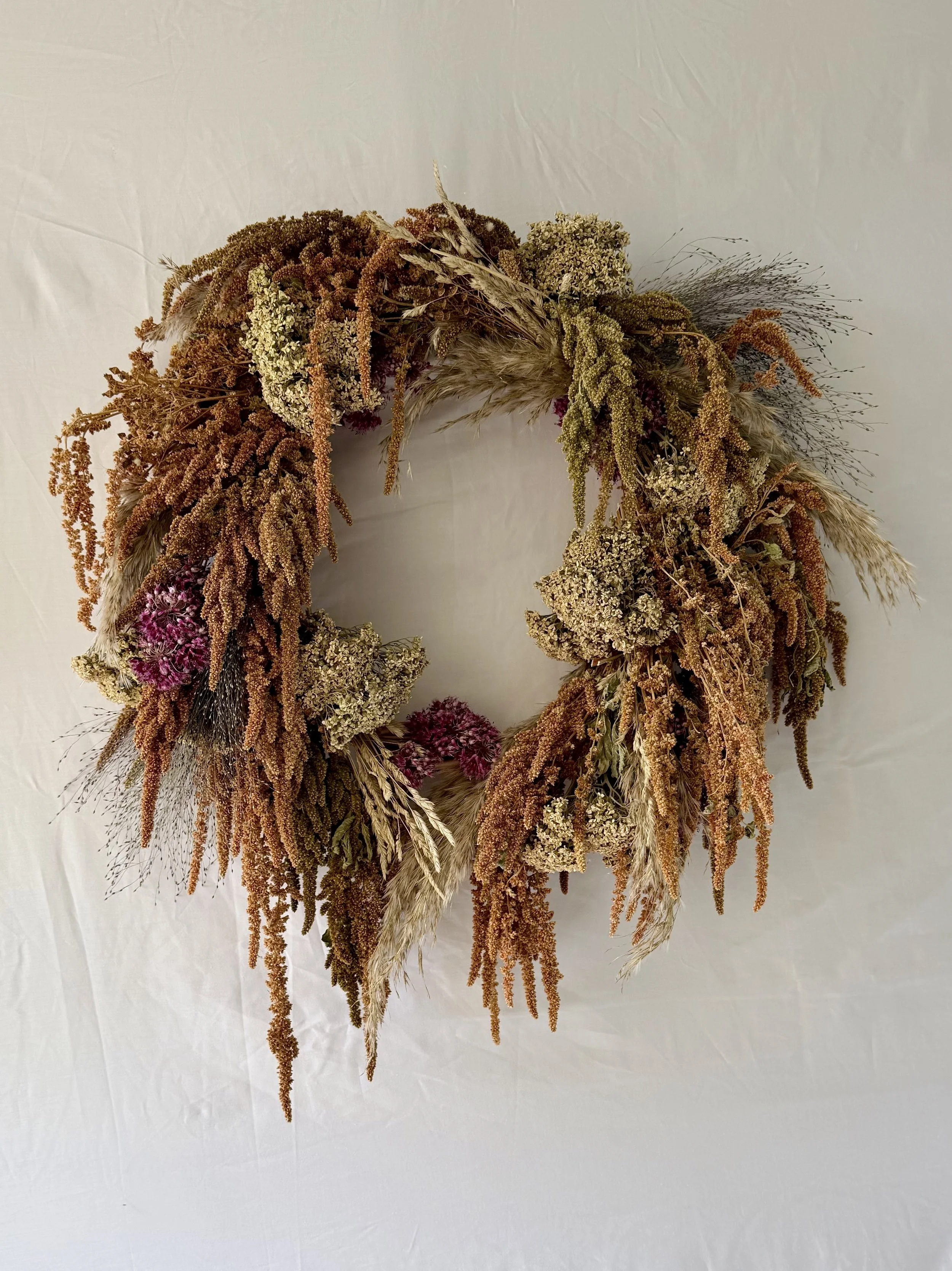
Wild carrot curls inwards as it goes to seed and creates the most beautiful little bird's-nest shape. Poppies leave sculptural seedheads behind. Flax produces delicate pods. Grasses become increasingly beautiful as they mature.
Things I might once have looked at and thought, that's finished, I now look at and wonder what it could become.
I deliberately grow some things with drying in mind, including ornamental grasses, extra wild carrot, poppies and flax.
Others are happy accidents.
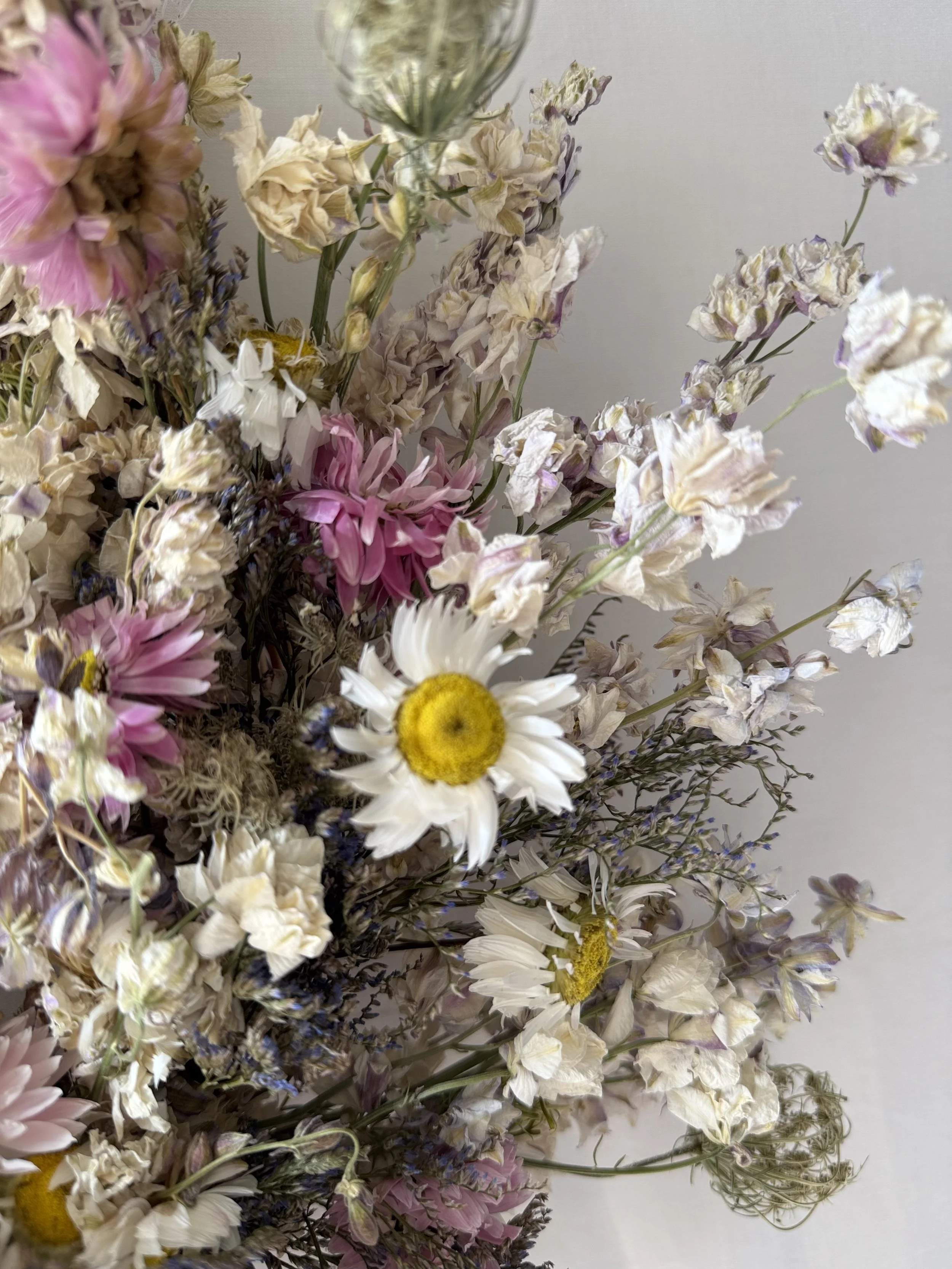
This summer, my rudbeckia and larkspur seemed to decide to flower all at once. There were simply too many stems for me to use fresh, so rather than sending the excess to the compost heap, I dried them.
Then there was my limonium.
I'd grown a seed mix that was supposed to give me lots of apricot, pink and white flowers for my fresh bouquets.
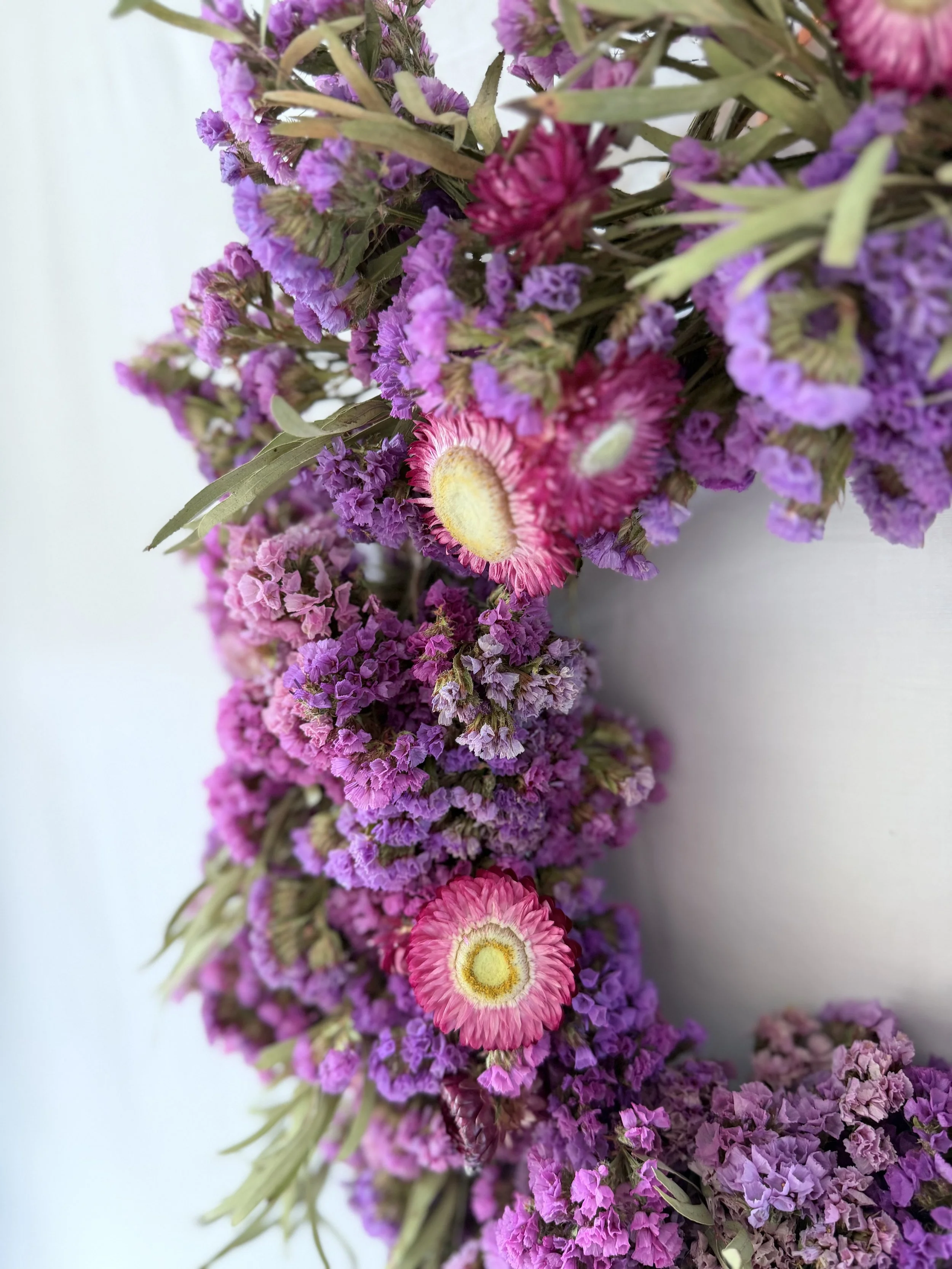
It turned out to be considerably more purple than advertised.
Luckily, limonium is one of those flowers that dries brilliantly.
So what wasn't quite what I'd planned during the fresh flower season has become boxes and boxes of material for my dried wreaths.
I don't design ten identical wreaths and then order the ingredients
This is where being a grower first and a florist second really comes into play.
I don't sit down at the beginning of the year, design a wreath and then order exactly the right quantities of each ingredient so that I can reproduce it ten times.
My collection builds organically.
Throughout the growing season, more bunches appear hanging from the roof of my garage. Seedheads are gathered. Grasses are dried. Something unexpected flowers beautifully and I save it. Something else doesn't turn out remotely as planned and I find another use for it.
As my collection grows, I start putting combinations together in my head.
That grass would look beautiful with that limonium.
Those seedheads would work with the lunaria.
That bracken has exactly the shape I need.
The materials start to dictate the wreath rather than the other way around.
That inevitably means there is some unpredictability. I can't promise that nature will give me precisely the same number of stems, in precisely the same colours, every year.
But I don't really want it to.
I'd much rather make something led by the flowers I actually grew that season than decide what nature ought to have produced and order the missing pieces from elsewhere.
Grown by me, gathered locally - and honest about what isn't
Not absolutely everything on my wreaths comes from my flower plot.
Alongside the flowers and grasses I grow, I use some locally gathered materials such as bracken, ferns and teasels.
And I don't grow my own willow.
My current flower plot is around 250 square metres and space is precious. If I have to choose between growing another bed of flowers and planting enough willow to supply my wreath bases, the flowers are going to win.
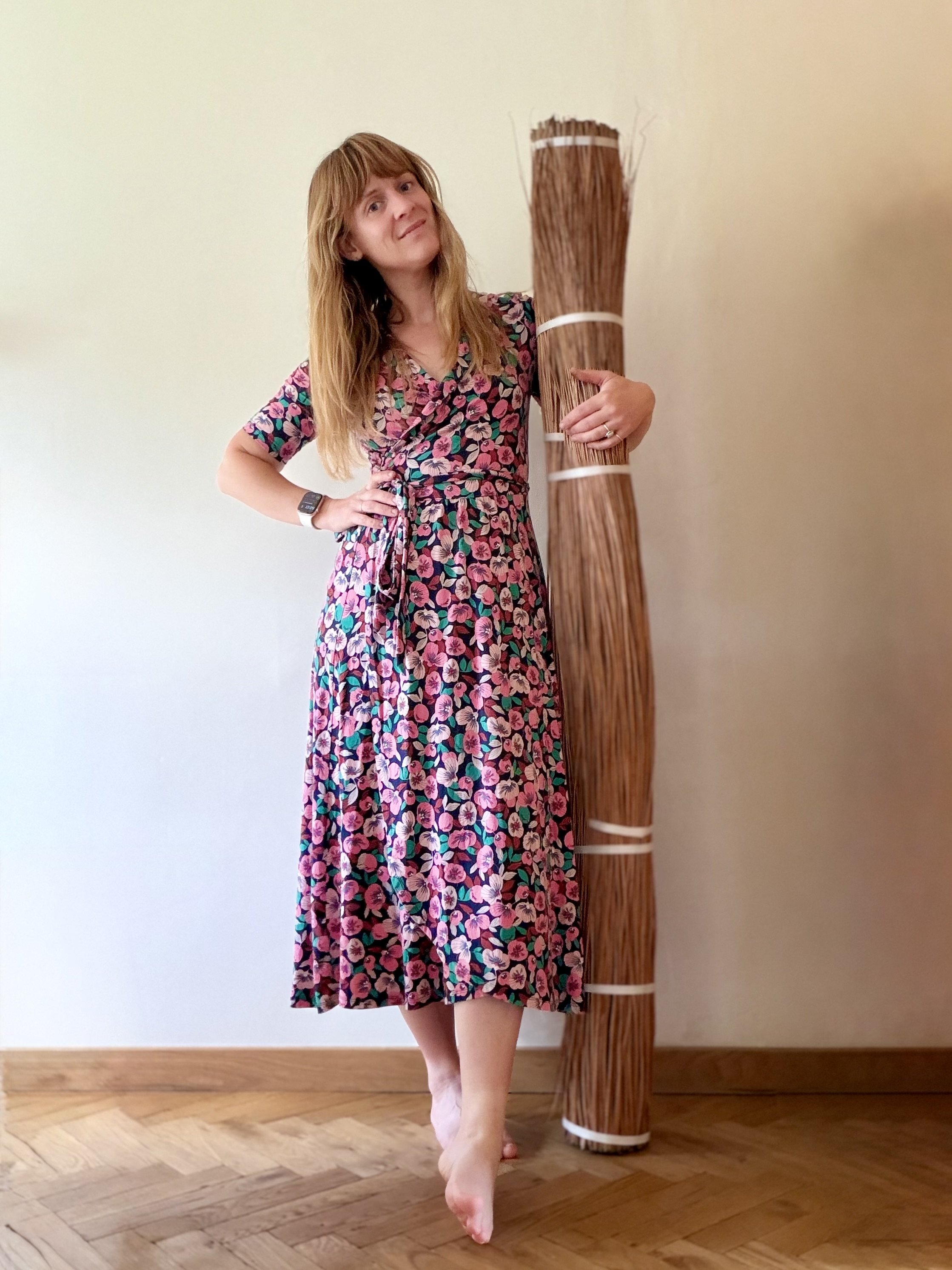
So I source my willow from Musgrove Willows in Somerset and weave the bases myself.
For me, supporting another British grower and being transparent about where my materials come from makes far more sense than pretending I can grow absolutely everything myself.
A winter wreath that actually begins in summer
By the time I sit down to make a dried flower wreath in autumn or winter, some of its ingredients may have been with me for months.
I might have sown the seed.
Raised the plant.
Planted it out.
Watered it.
Cut the flower.
Hung it from the garage ceiling.
Packed it carefully away.
And then, months later, picked it back up and woven it into a wreath.
I know where it came from because I was there for virtually its entire journey.
That's what I want Cicely Flowers to be about.
Seasonal flowers don't mean having flowers for only a few months of the year. They mean appreciating what each season gives us — and sometimes finding ways of preserving a little bit of one season to enjoy in the next.
So when you buy one of my dried flower wreaths in Bradford on Avon, it isn't simply a decoration I've assembled in winter.
It began on the flower plot months before.