
Behind the Scenes: Getting the Flowers ready for Valentine’s Day
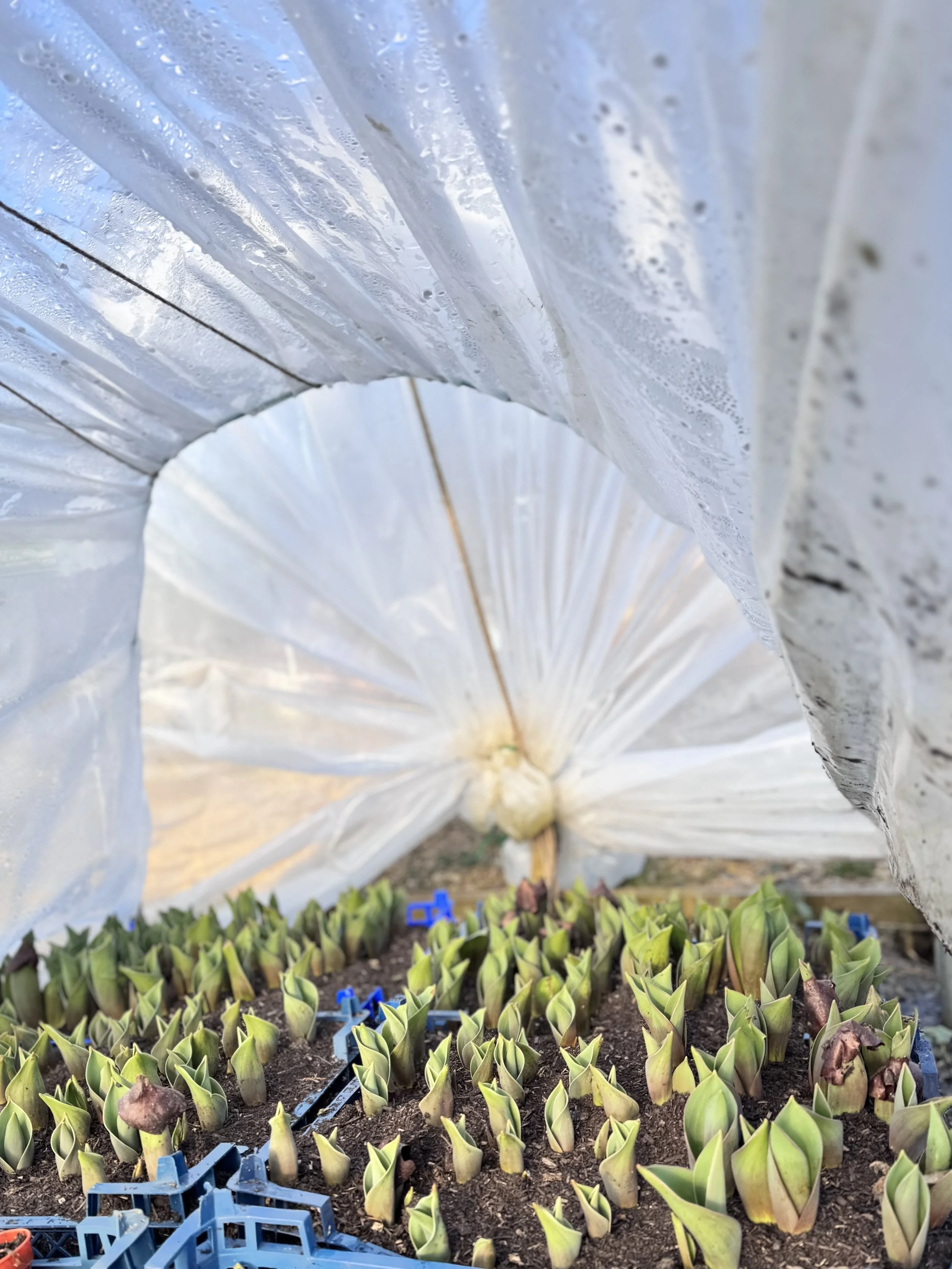
Valentine’s pre-orders are now open, and while the bouquets themselves won’t be ready for a few weeks yet, the work behind them has been quietly unfolding for months.
Each Valentine’s bouquet starts long before February, shaped by the seasons, the weather, and the careful choices made on the flower farm day after day. If you’ve ever wondered what really goes on in the run up to Valentine’s Day, this is a glimpse behind the scenes. Valentine’s Day is a particularly tricky time to grow flowers locally, as there’s very little that naturally wants to flower at this point in the year.
Planning months (and seasons) ahead
Unlike imported flowers, locally grown blooms don’t work to a fixed calendar date - they work to the weather. Valentine’s Day falls at a tricky point in the year, when winter is still very much holding on, so planning starts months in advance.
In late summer and autumn, I’m sowing and planting with February in mind: hardy annuals, biennials and bulbs that can cope with cold conditions and still give something special. Each sowing is a small gamble, balancing what should flower with what might flower depending on how the season unfolds.
By the time January arrives, the focus shifts from planting to protection.
Keeping everything at just the right temperature
The weeks leading up to Valentine’s Day are a constant dance with temperature. Too cold, and growth slows or stalls completely. Too warm, and everything rushes ahead far too early.
On frosty nights, crops are tucked in under layers of fleece in the polytunnel and outdoors. During the day, covers come off again to let in light and air, and vents are opened or closed depending on how the sun behaves. It’s a daily (sometimes hourly, when it comes to tulips!) check-in.
This careful temperature management is one of the least visible but most important parts of growing flowers for a specific moment. It’s slow, attentive work, and it’s what allows seasonal flowers to bloom at just the right time without forcing them unnaturally.
Watching, waiting, and adjusting
January and early February are full of observation. I’m walking the beds every day, checking bud development, stem length, and overall health. Some crops surprise me and race ahead, others sit tight and need a little encouragement.
If something looks like it might miss the window, plans are gently adjusted. Valentine’s bouquets are never identical because they reflect exactly what’s ready that week - a true snapshot of the season.
There’s a lot of letting go involved, too. Not every stem makes the cut, and that’s part of working with nature rather than against it.
Harvesting at the perfect stage
As the day approaches, harvesting becomes more frequent and more precise. Flowers are cut early in the morning when they’re fully hydrated, then conditioned carefully so they last as long as possible once they leave the farm.
Timing is everything. Cut too early and the flowers may not open properly; too late and their vase life is shortened. Each variety has its own sweet spot, learned through years of growing and close attention.
Buckets start to line the workspace, each filled with stems at slightly different stages, waiting to be brought together.
Creating Valentine’s bouquets
Bouquet-making happens quietly and deliberately. This isn’t mass production - it’s about balance, texture, and letting the flowers speak for themselves.
I’m looking for contrast: soft petals against structural stems, gentle colour shifts rather than bold uniformity. Every bouquet is slightly different, shaped by what the farm is offering that day.
Packaging is kept simple and considered, protecting the flowers while letting them be the focus. Cards are written, orders double-checked, and everything is lined up ready for collection or delivery.
Why seasonal Valentine’s flowers matter
Choosing locally grown, seasonal flowers for Valentine’s Day means embracing something more thoughtful and grounded. These flowers haven’t travelled thousands of miles or been grown out of season under intense artificial conditions.
Instead, they carry the story of winter soils, cold mornings, careful protection, and patient waiting. They’re a reminder that love, like growing, doesn’t need to be rushed to be meaningful.
A moment made from many small moments
By the time Valentine’s Day arrives, the busiest work is already done. What looks like a single day is really the result of months of planning and weeks of close, careful attention.
Every bouquet leaving the farm carries all of that unseen work with it - the frost checks, the fleece layers, the quiet hope that the timing would be just right.
And that, for me, is what makes Valentine’s flowers so special.